


The Great Migration 2026: A Journey Through Time, Nature, and Wonder in Tanzania and Kenya
- Jan 19
- 12 min read

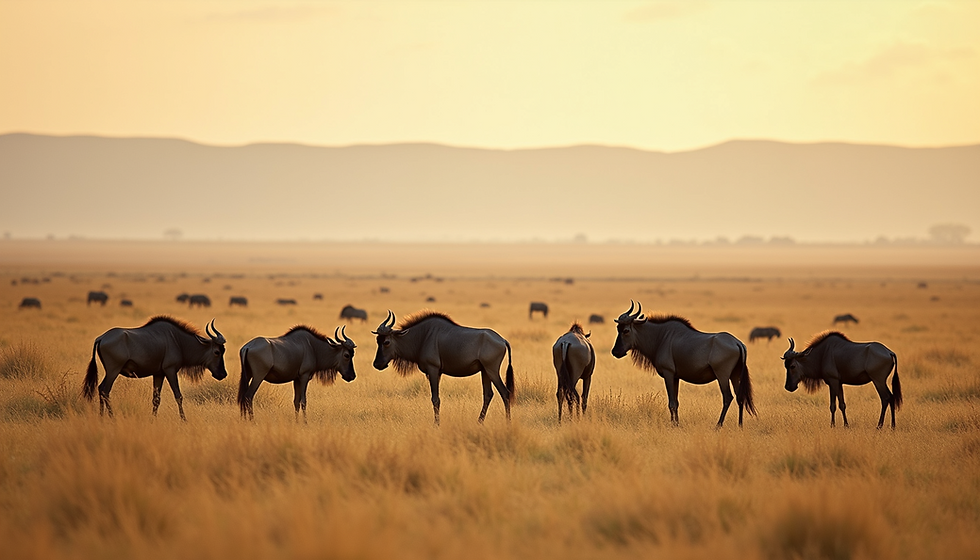
Imagine standing on a vast, golden plain as the first light of dawn spills over the horizon, painting the sky in hues of amber and rose. The air is still, cool with the breath of night, yet charged with anticipation. Then—a distant rumble. Not thunder, but something deeper, more primal: the synchronized footfalls of hundreds of thousands of hooves moving as one. Dust rises like incense from the earth. Zebras whinny, wildebeest bellow, and somewhere in the tall grass, a lioness tenses, eyes fixed on the chaos about to unfold. This is not a scene from a documentary or a dream—it is the Great Migration, happening right now, in real time, across the boundless savannas of Tanzania and Kenya.
In 2026, this ancient odyssey—often called the “Greatest Show on Earth”—is more than a wildlife spectacle; it is a living testament to the resilience of nature in an age of rapid change. For over a million wildebeest, half a million zebras, and countless gazelles, the migration is a matter of survival, dictated not by calendars or clocks, but by instinct honed over millennia and the ever-shifting rhythms of rain and grass. Their journey spans nearly 1,800 miles in a continuous loop through some of Africa’s most iconic landscapes: the volcanic plains of the southern Serengeti, the crocodile-infested waters of the Grumeti and Mara Rivers, and the acacia-dotted expanses of the Maasai Mara.
But what makes the Great Migration in 2026 uniquely compelling is not just its scale or drama—it’s the context in which it unfolds. We are living in a pivotal moment. Climate volatility is reshaping seasonal patterns. Conservation science is advancing at an unprecedented pace. Local communities are redefining their relationship with wildlife through innovative stewardship models. And travelers—more conscious and curious than ever—are seeking experiences that go beyond observation to connection, understanding, and responsibility.
This blog is your guide to experiencing the Great Migration in 2026—not as a passive spectator, but as an informed, respectful participant in one of Earth’s last great natural cycles. We’ll explore where the herds are likely to be throughout the year, how climate forecasts might influence their movements, which lodges and conservancies are leading the way in sustainability, and how your visit can contribute to the long-term protection of this irreplaceable ecosystem. Along the way, we’ll delve into the cultural heartbeat of the region—the Maasai and other Indigenous communities whose lives have intertwined with these lands for generations—and reflect on what the future holds for this fragile, magnificent dance of life.
Whether you’re planning your first safari or returning to witness the migration once more, 2026 offers a rare opportunity: to stand on the edge of eternity, to feel the pulse of the planet beneath your feet, and to carry forward a story that must never end.
Understanding the Great Migration: A Natural Clock
At its core, the Great Migration is not a spectacle staged for human admiration—it is a relentless, life-or-death journey governed by one of nature’s most precise yet invisible mechanisms: the seasonal rhythm of rainfall and grass. Often described as “the world’s longest overland migration,” this cyclical movement of over 1.5 million wildebeest, 300,000 zebras, and hundreds of thousands of Thomson’s gazelles is less a linear trek and more a vast, breathing loop—an ecological heartbeat that pulses across the Serengeti-Mara ecosystem year after year.
Unlike migrations driven by temperature or daylight (like those of birds or monarch butterflies), the Great Migration in East Africa is dictated almost entirely by nutrient availability. Wildebeest, the primary drivers of this phenomenon, are grazers with highly specific dietary needs. They require short, protein-rich grasses that flourish only in recently rained-upon soils. As soon as one area is grazed bare or the dry season sets in, the herds move—sometimes covering up to 40 kilometers in a single day—in search of greener pastures. Their movements are not random; they follow an ancient, instinctive map encoded in their DNA, refined over hundreds of thousands of years of evolution.
This creates what scientists call a “green wave”: a dynamic front of fresh growth that sweeps across the landscape with the rains, and which the herds surf like ocean travelers chasing perpetual spring. The timing of this wave shifts slightly each year based on climatic conditions, but the overall pattern remains remarkably consistent—a testament to the resilience of natural systems even in the face of growing environmental pressures.

The Annual Cycle: A Month-by-Month Breakdown
January – March: The Miracle of Birth (Southern Serengeti & Ndutu, Tanzania)
The year begins not with departure, but with arrival—of new life. During the short dry season in the southern Serengeti and the Ndutu plains near the Ngorongoro Conservation Area, nutrient-rich volcanic soils support lush short-grass plains. This is calving season. In just three weeks during February, an estimated 500,000 wildebeest calves are born. The strategy is one of overwhelming odds: predators like lions, hyenas, and cheetahs are everywhere, but sheer numbers ensure that enough calves survive. For visitors, this is a time of tender vulnerability and raw drama—newborns taking their first wobbly steps within minutes of birth, mothers fiercely protective, and predators testing the edges of the herd.
April – May: The Long Rains and the First Exodus (Central & Western Serengeti)
As the long rains arrive in April, the southern plains flood and the grasses grow tall and fibrous—less nutritious for grazing. The herds begin their slow, meandering march northwest toward the central Serengeti (Seronera Valley) and then west into the Grumeti region. This leg is less about urgency and more about gradual transition. The landscape transforms into a sea of green, rivers swell, and access becomes challenging—many roads turn to mud, and some lodges close temporarily. Yet this is also a time of solitude: fewer tourists, dramatic skies, and intimate wildlife encounters away from the crowds.
June: Gathering Momentum (Western Corridor & Grumeti River)
By June, the dry season tightens its grip. Water sources dwindle, and the herds consolidate into massive columns heading toward the Grumeti River. Here, the first major river crossings occur—not as famous as the Mara River, but no less perilous. Nile crocodiles, some over 15 feet long, lie in wait. The crossings are chaotic, often involving trial-and-error as wildebeest test the currents, sometimes drowning in the process. This is also prime time for observing large predator activity, as lions and leopards capitalize on the concentrated prey.
July – October: The Mara River Crossings (Northern Serengeti & Maasai Mara, Kenya)
This is the migration’s most iconic phase. By July, the leading edge of the herds reaches the northern Serengeti, and by late July or early August, they spill across the border into Kenya’s Maasai Mara National Reserve. The Mara River—deceptively calm in appearance—becomes a theater of survival. Herds gather on the banks for days, driven by hunger but paralyzed by fear. Then, suddenly, a few bold individuals plunge in, triggering a mass surge. Crocodiles strike, wildebeest slip on muddy banks, calves get separated, and predators patrol the shores. These crossings can happen multiple times as herds cross back and forth in search of optimal grazing. For photographers and wildlife enthusiasts, this is peak season—but also peak tourism, so planning ahead is essential.
November – December: The Return South (Loliondo, Lobo, and Back to Ndutu)
With the onset of the short rains in November, fresh grass sprouts in the southeast Serengeti. The herds sense the change and begin their long return journey south. This leg is often overlooked by tourists, but it offers incredible value: fewer vehicles, lower prices, and the chance to witness the migration in quieter, more remote sectors like Lobo or the eastern Serengeti. By December, the cycle nears completion as the herds approach Ndutu once more, ready to give birth and begin the epic anew.
Why It’s Called a “Clock”
The Great Migration functions like a biological clock because it is predictable in pattern but fluid in timing. Just as a clock’s hands move steadily but can be adjusted for daylight saving time, the migration follows a reliable annual arc—but its exact dates shift based on rainfall, drought, or even localized fires. In 2026, this “clock” is being subtly recalibrated by climate change. Scientists have observed that the long rains are arriving later and ending sooner, compressing the window for calving and altering traditional routes. Some herds now linger longer in the Maasai Mara or split into smaller groups exploring new corridors.
Yet despite these changes, the fundamental rhythm endures. The migration persists not because animals “know” where to go, but because those who followed the rains survived—and passed on their instincts. It is evolution in motion, a living archive of adaptation written in hoofprints across the savanna.
In understanding this natural clock, we gain more than logistical insight for travel planning. We glimpse a deeper truth: that life on Earth is not static, but a continuous flow—responsive, interconnected, and breathtakingly resilient. And in 2026, as we stand at the intersection of wonder and responsibility, witnessing this clock tick may be one of the most profound experiences a traveler can have.
Where to Witness the Great Migration in 2026: A Strategic Guide Across Tanzania and Kenya
In 2026, the Great Migration remains as dynamic as ever—but knowing where to go at the right time can mean the difference between witnessing a life-changing spectacle and missing it entirely. Because the herds are constantly on the move, your ideal destination shifts with the seasons, rainfall patterns, and even real-time ecological conditions. Fortunately, both Tanzania and Kenya offer world-class viewing opportunities across a spectrum of landscapes—from luxury tented camps overlooking river crossings to community-run eco-lodges deep in private conservancies.
Below is a detailed, month-by-month guide to the best places to experience the migration in 2026, tailored for photographers, families, solo travelers, and conservation-minded adventurers alike.
🇹🇿 TANZANIA: The Serengeti – Where the Journey Begins and Ends
1. Southern Serengeti & Ndutu Plains (January – March)
Why it’s special in 2026:This is calving season—the most emotionally powerful and biologically significant phase of the entire migration. In early 2026, climate models suggest slightly drier conditions in January, which could concentrate herds more densely around reliable water sources near Lake Ndutu and the short-grass plains south of Naabi Hill.
What you’ll see:
Thousands of wildebeest giving birth within a narrow window (peak in February)
Predator action at its most intense: lions, cheetahs, and hyenas hunting vulnerable newborns
Zebras and gazelles mingling with wildebeest in vast, open landscapes
Best lodges & camps:
&Beyond Serengeti Under Canvas – A mobile luxury camp that relocates monthly to stay close to the herds.
Nomad Tanzania’s Ndutu Safari Lodge – Solar-powered, eco-conscious, and perched on the edge of the Ndutu woodlands.
Lemala Nanyukie – Offers panoramic views of the plains and strong community partnerships.
Travel tip:January and February are high season in the south. Book 12–18 months in advance for top-tier mobile camps.
2. Central Serengeti (Seronera Valley) – April to May
Why it’s special in 2026:As the long rains begin, many operators pull out—but this is when the Serengeti reveals its quieter soul. In 2026, improved all-weather roads and upgraded lodge infrastructure mean better access even during wet months. Fewer vehicles = more intimate wildlife experiences.
What you’ll see:
Herds moving through acacia woodlands and riverine forests
Excellent big cat sightings (Seronera is known as “lion alley”)
Lush green landscapes, dramatic thunderstorms, and newborn impalas
Best lodges & camps:
Four Seasons Safari Lodge Serengeti – Luxury with sustainability credentials and a hilltop infinity pool overlooking game trails.
Serena Serengeti Lodge – Recently renovated with solar energy and water recycling systems.
Ubuntu Camp – A semi-permanent eco-camp offering value without sacrificing comfort.
Travel tip:April is low season—great for budget-conscious travelers seeking solitude and lower rates.
3. Western Corridor & Grumeti Reserve (May – June)
Why it’s special in 2026:The western Serengeti is gaining attention as a premium, low-density alternative to the crowded northern routes. In 2026, new conservation agreements between the Tanzanian government and private operators have expanded protected corridors along the Grumeti River, reducing human encroachment and improving wildlife flow.
What you’ll see:
First major river crossings of the season
Huge crocodiles ambushing wildebeest in narrow river channels
Rare species like roan antelope and black-and-white colobus monkeys
Best lodges & camps:
Singita Faru Faru & Sabora Tented Camp – Ultra-luxury, conservation-focused, and part of a 350,000-acre reserve.
Mbalageti Serengeti – Mid-range option with stunning views over the Grumeti plains.
Serengeti Pioneer Camp – Stylish, mobile, and positioned for optimal migration tracking.
Travel tip:The Grumeti crossings are less predictable than the Mara River—but far more exclusive. Ideal for travelers seeking drama without crowds.
4. Northern Serengeti (Kogatende & Lamai) – July to October
Why it’s special in 2026:This is Tanzania’s answer to the Maasai Mara—and in 2026, it’s becoming increasingly popular as travelers seek to avoid Kenyan park congestion. New e-visa integrations and direct flights to Kogatende airstrip (launched in late 2025) make access easier than ever.
What you’ll see:
Dramatic Mara River crossings from the Tanzanian side (same river, different perspective)
Herds massing on steep, muddy banks before plunging in
Leopards in riverine forests and large elephant herds
Best lodges & camps:
Serengeti Migration Camp – Perched on a bend of the Mara River with panoramic views.
Lamai Serengeti – Minimalist luxury built into granite kopjes; perfect for photography.
Chaka Camp – Eco-friendly, mobile, and run by a B Corp-certified operator.
Travel tip:July and August are peak months—book early. September offers slightly fewer crowds and equally good crossing activity.

🇰🇪 KENYA: The Maasai Mara – Theater of the Crossing
1. Maasai Mara National Reserve (July – October)
Why it’s special in 2026:Despite growing pressure from tourism, the Maasai Mara remains the most iconic stage for river crossings. In 2026, the reserve has implemented a vehicle cap system at major crossing points (like Talek and Musiara) to reduce stress on wildlife—a win for ethical tourism.
What you’ll see:
Mass crossings with hundreds of animals surging through crocodile-filled waters
Lions dragging prey up embankments
Vultures circling overhead, hyenas scavenging leftovers
Best lodges & camps:
Angama Mara – Perched on the Oloololo Escarpment with floor-to-ceiling views of the reserve.
Governors’ Il Moran Camp – Classic luxury tents on the banks of the Mara River.
Mara Intrepids – Family-friendly, great value, and located near key crossing sites.
Travel tip:Stay inside the reserve for quick access to crossings—but expect higher fees and more vehicles.
2. Private Conservancies (July – October, and year-round)
Why it’s special in 2026:Kenya’s private conservancies—community-owned lands adjacent to the Maasai Mara—are where the future of safari lies. In 2026, over 15 conservancies operate under strict sustainability charters, limiting beds, banning plastic, and channeling 80%+ of revenue directly to local Maasai landowners.
Top conservancies to consider:
Olare Motorogi Conservancy – Ultra-low density (1 guest per 700 acres), home to Cottar’s and Mahali Mzuri.
Naboisho Conservancy – Pioneering community model; excellent for walking safaris and night drives.
Mara North Conservancy – Scenic, well-managed, and rich in biodiversity.
What you’ll experience:
Off-road driving (allowed in conservancies, not in the national reserve)
Guided walks with Maasai warriors
Night game drives and cultural visits
Fewer than 10 vehicles at any sighting
Best lodges:
Cottar’s 1920s Camp – Vintage glamour meets conservation leadership.
Basecamp Explorer’s Naboisho Camp – Carbon-neutral and deeply embedded in community development.
Elewana Sand River Masai Mara – Elegant riverside location with private crossing viewpoints.
Travel tip:Conservancy fees are higher than park fees, but they include all activities and directly support local livelihoods—making them the most ethical choice in 2026.

Ethical Travel Tips for 2026: Travel with Purpose with The Image of Tanzania Safaris
At The Image of Tanzania Safaris, we believe that witnessing the Great Migration isn’t just about breathtaking views or bucket-list moments—it’s about responsibility, respect, and reciprocity. As a homegrown Tanzanian tour operator founded and led by local residence, we’ve built our philosophy around one core truth: the future of Africa’s wild spaces depends on how we travel today.
In 2026, ethical travel is no longer optional—it’s essential. Here are our top recommendations for experiencing the Great Migration with integrity, impact, and heart.
1. Choose Local, Choose Right
Not all safari companies are created equal. When you book with The Image of Tanzania Safaris, you’re not just reserving a trip—you’re investing directly in Tanzanian communities. Over 90% of our staff are local residence, and we partner exclusively with locally owned lodges, camps, and conservancies. This ensures that tourism revenue stays where it belongs: in the hands of those who protect these lands every day.
2. Respect Wildlife—Always
The drama of the Mara River crossing or the tenderness of a newborn calf can stir powerful emotions—but never let excitement override ethics. At The Image of Tanzania Safaris, our certified guides follow strict Wildlife Viewing Protocols endorsed by the Tanzania National Parks Authority (TANAPA):
Maintain a minimum distance of 25 meters from animals
Never block migration paths or river crossing points
Avoid loud noises, sudden movements, or drone use near herds
Never feed or attempt to touch wildlife
Remember: we are guests in their world. Our presence should leave no trace but awe.
3. Support Community-Led Conservation
In 2026, the most impactful safaris happen in community conservancies—areas where Indigenous groups like the Maasai manage land for both people and wildlife. We proudly offer itineraries that include stays in places like the Loliondo Wildlife Management Area and partnerships with women’s beadwork cooperatives near Ngorongoro.
When you visit a village or buy crafts:
Always ask permission before taking photos
Pay fair prices (never haggle aggressively)
Prefer cooperatives over roadside vendors to ensure income reaches families
💡 On our “Conservation & Culture” tours, 10% of your fee funds anti-poaching patrols and girls’ education programs in northern Tanzania.
4. Travel Light on the Planet
We’ve eliminated single-use plastics across all our vehicles and camps. We encourage guests to bring reusable water bottles (we provide filtered water), reef-safe sunscreen, and biodegradable toiletries. In 2026, we’re also offsetting 100% of carbon emissions from road transfers through verified reforestation projects in the Eastern Arc Mountains.
🌱 Did you know? A single safari vehicle idling for an hour emits as much CO₂ as charging your phone for two years. That’s why our drivers turn off engines during sightings—unless you’re photographing!
5. Be a Humble Witness, Not a Director
The migration doesn’t perform on command. Some days, the herds rest. Some crossings happen at night. And that’s okay. At The Image of Tanzania Safaris, we teach our guests to embrace the unpredictability of nature. True connection comes not from chasing spectacle, but from sitting quietly, listening to the wind, and letting the wild reveal itself on its own terms.
🕊️ As our Maasai guide Lekur says: “The wildebeest do not migrate for your camera. They migrate because life demands it. Watch with your heart, not just your eyes.”
6. Leave a Legacy, Not Just Footprints
After your safari, stay connected. Share stories that honor the land and its people—not just the “epic hunt” or “crazy crocodile.” Tag responsibly. Support organizations like the Serengeti Conservation Project or Mara Predator Conservation Programme. And consider returning—not just as a tourist, but as a long-term ally.
At The Image of Tanzania Safaris, we don’t just show you Tanzania—we invite you to care for it. Because when you travel ethically, you don’t just see the Great Migration… you help ensure it continues for generations to come.
Ready to experience the 2026 Great Migration the right way?
Contact The Image of Tanzania Safaris today for a custom, conservation-led itinerary designed by locals who call these plains home.
🌍 Proudly Tanzanian. Deeply Responsible. Wildly Inspired.
| 📞 +255 694 960 430


Comments